Yay! You did it.
Someone reached out and wants to hire you.
Maybe it was a friend who saw your balloon garland on Facebook. Maybe someone found your photos on Instagram or Pinterest. However it happened, your heart is probably doing a little happy dance right now. I’m doing a happy dance for you, too!
Then reality sets in.
Now what?
- Do you need a contract?
- Should you ask for a deposit?
- What if they change their mind?
- Do you need insurance before you say yes?
- Should you have an LLC?
- What information do you need before you even start buying specific balloons for their event?
If those questions are running through your mind, take a deep breath. Every small business owner has been exactly where you are.
You don’t have to figure everything out on the fly. A simple system takes away much of the stress because you know what comes next. Instead of wondering whether you’ve forgotten something important, you’ll have a process you can follow every time a new call or message comes in.
No business is built on just remembering every detail. They’re built on systems that help you deliver a great experience for every client.
In this guide, I’ll walk through the paperwork, contracts, deposits and organizational habits with you. All the processes that can make your business feel professional from day one.
It’s not as intimidating as it sounds. And it feels huge right now because it’s your first client! (eeee!) But once you have your system in place, you’ll be able to spend less time worrying about the business side. You can get into doing what you actually enjoy which is creating beautiful balloon displays.
Collect the Right Information First
It’s exciting when someone wants to book you. Try not to jump straight into talking about balloons.
Before you start discussing colors, sizes or pricing, spend a little time learning about the event itself. Gather the information first. It’s important to give the customer an accurate quote.
- When is the event?
- Where is it being held?
- Is it indoors or outdoors?
- What’s the occasion?
- Are there specific colors or a theme they want you to match?
- Will you be creating a simple balloon garland or decorating a larger space?
As you gain experience, you’ll discover there are other details worth asking about, too. Is there a specific time you can set up, or will you have a limited window before guests arrive? Are the ceilings especially high? Will you need a ladder? Is there someone you’ll meet when you arrive at the venue?
You don’t have to remember all of these questions every time someone contacts you. That’s where a client questionnaire becomes incredibly helpful.
It doesn’t have to be anything fancy. Some decorators use a printable form. Others create a simple Google Form that clients fill out online. The important thing is that every client answers the same questions so you don’t accidentally forget something important.
It’s also a good idea to ask for inspiration photos. Sometimes a client says they want “something simple,” while picturing an elaborate organic balloon installation they found on Pinterest. Seeing photos early helps everyone start with the same expectations and makes it much easier to provide an accurate quote.
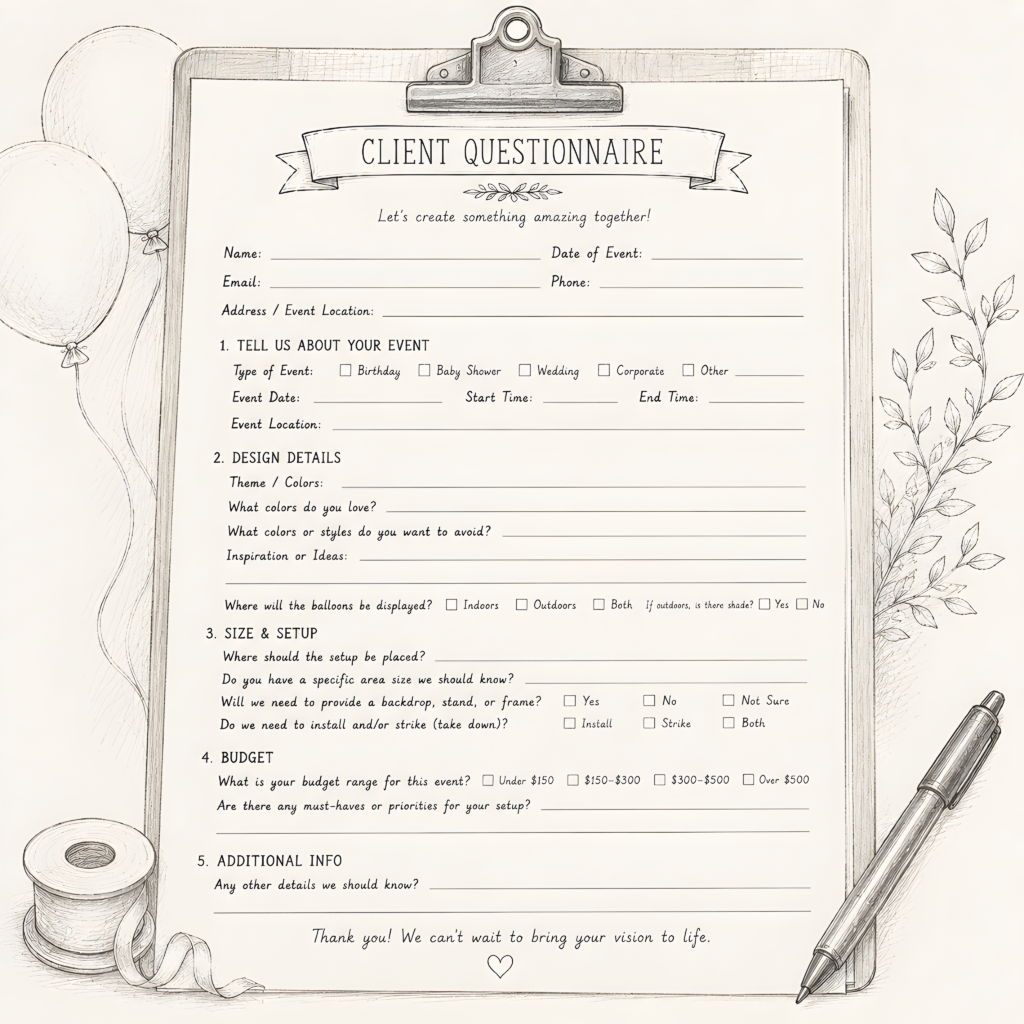
Taking a few extra minutes to gather information at the beginning can save hours of confusion later. It also shows clients that you’re organized and professional even if this is one of your very first bookings.
The more questions you ask before the event, the fewer surprises you’ll have on setup day.
Why Every Balloon Business Needs a Contract
The word “contract” can sound intimidating when you’re just starting out. It feels so…official and business-y. You might even wonder if you really need one when you’re decorating a birthday party for someone in your community.
The answer is yes.
Not because you expect something to go wrong, but because people forget things.
A client remembers asking for gold balloons. You remember hearing rose gold. Someone thought the setup included a backdrop. Someone else assumed teardown was part of the price. None of those misunderstandings happen because either person is trying to be difficult. They happen because conversations are easy to forget.
A contract simply puts everything in writing so everyone is working from the same plan. Your contract should clearly explain what you’re providing and what the client can expect. It doesn’t have to be complicated especially when you’re first getting started.
Some of the most important things to include are:
- The event date, time and location
- A description of the balloon decor you’re providing
- What’s included in the price
- What’s not included
- Delivery and setup information
- Whether pickup is included if applicable
- Who is responsible if balloons are damaged after setup
- Weather policies for outdoor events
- Your payment schedule, including deposits and final payment
Think of your contract as a written conversation. Instead of relying on everyone to remember what was discussed a month ago, you have one document that everyone can refer back to.
It also gives your business a much more professional feel. Clients appreciate knowing exactly what they’re paying for and what will happen next. It builds confidence because everything is clearly explained before the event.

A good contract doesn’t just protect your business. It protects your relationships, too.
It doesn’t matter if you’re working with your best friend or someone you’ve never met before. When you have everything written down, it can prevent awkward misunderstandings later (and dreaded bad reviews!) Everyone can enjoy the event instead of trying to remember who said what.
Deposits and Payments
Talking about money can feel uncomfortable when you’re new to business. For many people, asking for a deposit feels like asking for a favor. In reality, it’s simply part of running a business.
A deposit shows that both you and your client are committed to the event. They need that as much as you do. They want to know they have things covered for their event. It gives you the confidence to block that date on your calendar and begin planning for the job.
Without a deposit, there’s always the possibility for misinformation and cancellations. That can be devastating if you’ve already turned away another client for that day. It leads to wasted supplies and wasted time when you’ve been working toward the event.
Every business handles deposits a little differently. Some decorators ask for a percentage of the total cost. Others charge a flat amount. The important thing isn’t choosing the “perfect” deposit. Pick an amount or a percentage and apply that to every single event client. After the first couple of times, you’ll become more comfortable. You’ll even realize that it saves you when things could have gone wrong.
The same goes for final payments. Let clients know when the remaining balance is due and which payment methods you accept. It could be as simple as Cashapp or Venmo on your phone. You don’t have to have a complicated payment system if you don’t want one. Later, you can decide to switch to something like Square, Stripe, or Intuit. Those methods also make your taxes easier, too.
At this point, we should go over cancellations and refunds. Life happens. Parties get postponed. Venues close unexpectedly. Have a written cancellation policy before any problems raise their ugly heads. Being prepared ahead of time makes it much easier to handle those situations in a fair and consistent way.
One of the biggest mistakes new decorators make is buying balloons and supplies before receiving a deposit. It’s easy to get excited and want to start shopping right away. Or using what you’ve bought ahead of time when you were practicing. Wait until the deposit has been received. It will protect both your time and your money.
Clients aren’t offended by clear payment policies. In fact, most expect them. Setting expectations from the beginning makes your business feel organized, trustworthy and professional.
Think of your deposit as reserving a spot on your calendar, not just paying for balloons.
Once you’ve committed that date to one client, it’s no longer available to anyone else. That’s why deposits are such an important part of protecting your business.
Do You Need an LLC?
This is one of those questions almost every new business owner asks.
“Do I need an LLC before I can book my first client?”
You won’t like to hear this, but it depends.
What your business needs to operate is different in every city and state. Some balloon decorators begin as sole proprietors and later decide to form an LLC as their business grows. Others choose to set up an LLC before they book their first event.
Neither choice is automatically right or wrong.
What’s important is understanding the options available where you live and making the decision that’s best for your situation.
As you’re researching, you’ll probably come across terms like “sole proprietor,” “LLC” and “business entity.” Don’t let the terminology intimidate you. Every business owner had to learn these terms at some point, and you don’t have to become a legal expert overnight.
A **sole proprietorship** is the simplest way to run a business. You and the business are legally the same entity.
An **LLC (Limited Liability Company)** is a separate legal business entity that can offer liability protection for the business owner depending on the situation and local laws.
Don’t let the terminology intimidate you. Every business owner had to learn these terms at some point, and you don’t have to become a legal expert overnight.
A good place to start is by checking with your local or state government to learn what your area requires. You may also find it helpful to speak with a tax professional or visit a Small Business Development Center (SBDC). These organizations exist to help new business owners understand the legal and financial side of starting a business.
The important thing is to avoid making assumptions based on what someone else is doing. The requirements for a balloon decorator in another state, or the town next door, could be completely different from yours.
This article is meant to introduce the topic, not provide legal or tax advice. Taking a little time to research your local requirements now can help you avoid headaches later and give you confidence that you’re building your business on a solid foundation.
Don’t let paperwork become an excuse to put your business on hold.
Make a list of the questions you need answered, spend an afternoon researching your local requirements and check them off one by one. Breaking it into small steps makes the legal side of business feel much more manageable.
Business Licenses, Sales Tax and Insurance
Now let’s talk about three topics that tend to make new business owners nervous: business licenses, sales tax and insurance.
Take another deep breath. These are the heavy things us creatives really don’t love. But you don’t have to become an expert on all of them today. Or ever actually!
Think of this section as your introduction to the topics so you know what questions to ask as your business grows.
Depending on where you live, you may need a business license before you begin operating. Some cites and states also require businesses to collect sales tax on certain products or services. Because these rules vary by state, county and even city, it’s important to research the requirements where you live rather than relying on advice from someone in another area. Especially from someone (like me) on the internet. Nobody can know the laws in every area.
Insurance is another topic you’ll hear about often. Many balloon decorators eventually purchase general liability insurance to help protect themselves and the business. In fact, some event spaces won’t allow vendors to set up without proof of insurance. That could tank everything before you’ve even signed a client.
On a brighter note, you don’t have to figure all of this out alone. Your local government website is often a great place to start and organizations like your Small Business Development Center can point you toward the resources you need.
The most important thing to remember is that every business starts somewhere. Learning about licenses, taxes and insurance isn’t meant to overwhelm you. It’s simply another step toward building a business that’s prepared for future growth.
When you’re researching local requirements, create a simple checklist instead of trying to remember everything. Crossing off one item at a time feels much less overwhelming than staring at a long list of “business stuff” you think you’re supposed to know.
Staying Organized
If there’s one habit that will make your business feel professional from the very beginning, it’s staying organized. I don’t know your creative brain, but mine needs the contracts, and labels, and paperwork to stay on track. It doesn’t have to be overly complicated. When you first start, you probably want to bare bones it. At least until you decide this is your path.
You don’t need a fancy office or expensive software. You just need a system you’ll actually use.
Think about all the information that starts piling up once you begin booking clients. Event dates. Contact information. Contracts. Receipts. Photos. Supply lists. Before long, trying to remember where you saved everything becomes a full-time job.
Creating a simple organization system now will save you countless hours later.
Start with a calendar where you can keep track of inquiries, consultations, setup dates and event days. Having everything in one place makes it much easier to avoid scheduling conflicts.
Next, create a client tracker. This can be as simple as a spreadsheet with names, event dates, contact information and the status of each booking. You’ll always know who’s paid a deposit, who’s waiting for a quote and what still needs to be done.
It’s also a good idea to keep your business paperwork together. Save contracts, invoices, receipts and expense records in one place instead of hunting through emails every time you need something. If you decide to go with signatures and electronic payments, you should still print things out for your records.
Don’t forget about your photos, either. Organizing your event pictures into folders makes it much easier to update your portfolio, post on social media or find examples when a future client asks, “Have you ever made something like this before?”
As your business grows, you may also want to keep a simple inventory of your most-used supplies. Knowing how many balloon pumps, decorating strips or command hooks you have on hand can save you from making a last-minute trip to the store the night before an event.
None of these systems have to be perfect. They just have to make your life a little easier.
Future You will absolutely love and appreciate an organized Present You.
Spend 5 minutes filing a receipt in the right folder. Update your client tracker. Add the newest event to your calendar immediately. Put photos into the right spot today. All of these things will save you time and frustration when you’re preparing for your next event. No scrambling the night before the event. No panic during tax season.
Create a Simple Booking Workflow
One of the best things you can do for your business is create a booking process and use it for every client.
Create a basic workflow that can become the standard in your business. You’ll do it every time you book a client. You can change it later if you want, but start with something real simple.
A basic booking workflow might look like this:
**Inquiry**
A potential client reaches out to ask about your services.
↓
**Questionnaire**
Gather the information you need about the event before discussing designs or pricing.
↓
**Quote**
Review the details and provide a proposal based on the size and scope of the project.
↓
**Contract**
Once the client is ready to move forward, send your contract outlining exactly what’s included.
↓
**Deposit**
Reserve the event date after the deposit has been received.
↓
**Purchase Supplies**
Now you can confidently order balloons and any specialty items you need for the event.
↓
**Build**
Create the balloon garland or installation.
↓
**Install**
Deliver and set up the decorations at the venue.
↓
**Final Payment**
If there’s a remaining balance, collect it according to the payment schedule in your contract.
↓
**Follow-Up**
After the event, thank your client, ask for feedback or a review and, with their permission, share photos of your work on social media or in your portfolio.
You don’t have to memorize this process. In fact, I’d recommend you don’t.
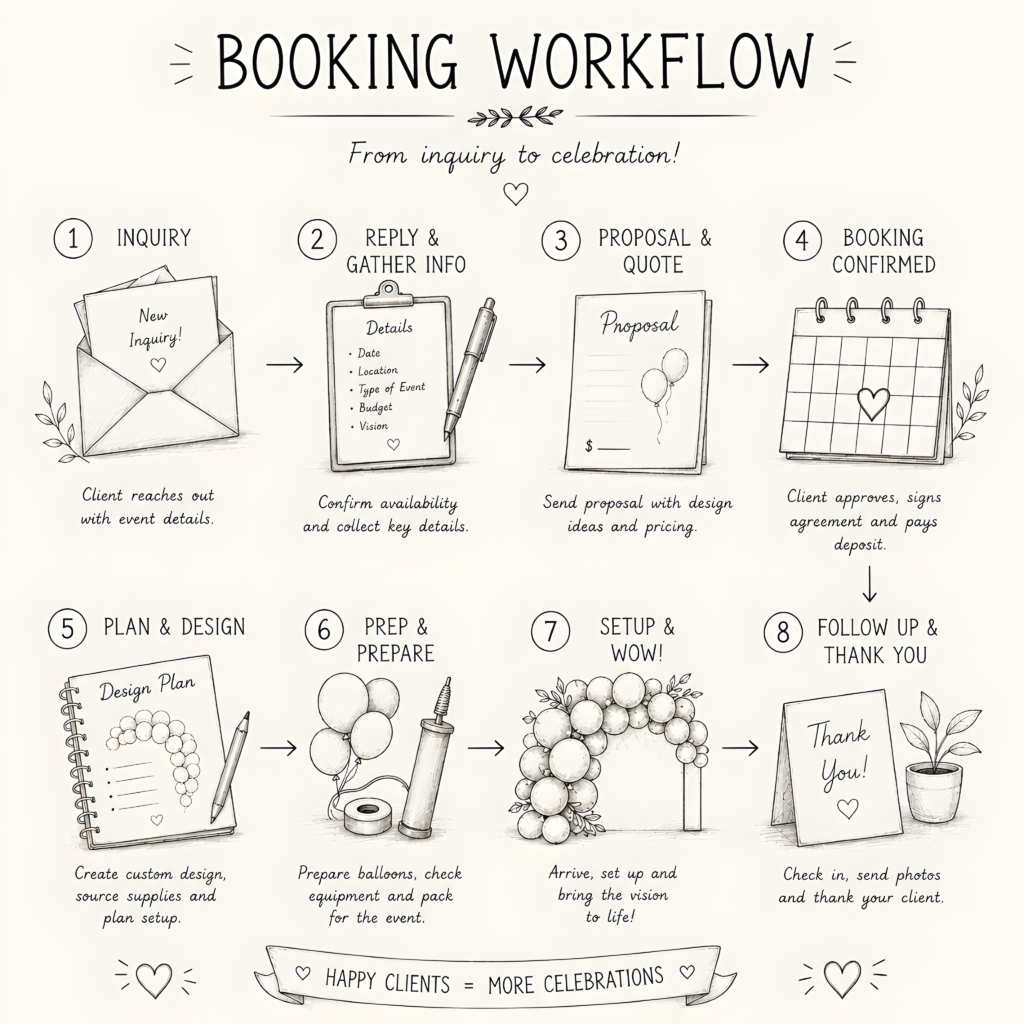
Create a workflow that makes sense to you. Follow it every time someone reaches out. If you’re forgetful (like me), having the steps written down can be a lifesaver. Better yet, automate what you can.
For example, you might automatically send every new inquiry a client questionnaire before you even start talking about balloon designs.
It might feel a little strange at first. You want to hear all about their event, brainstorm ideas and start imagining the perfect balloon installation. That’s the fun part! Creativity is why you wanted to start this business in the first place.
But creativity without a system can become expensive.
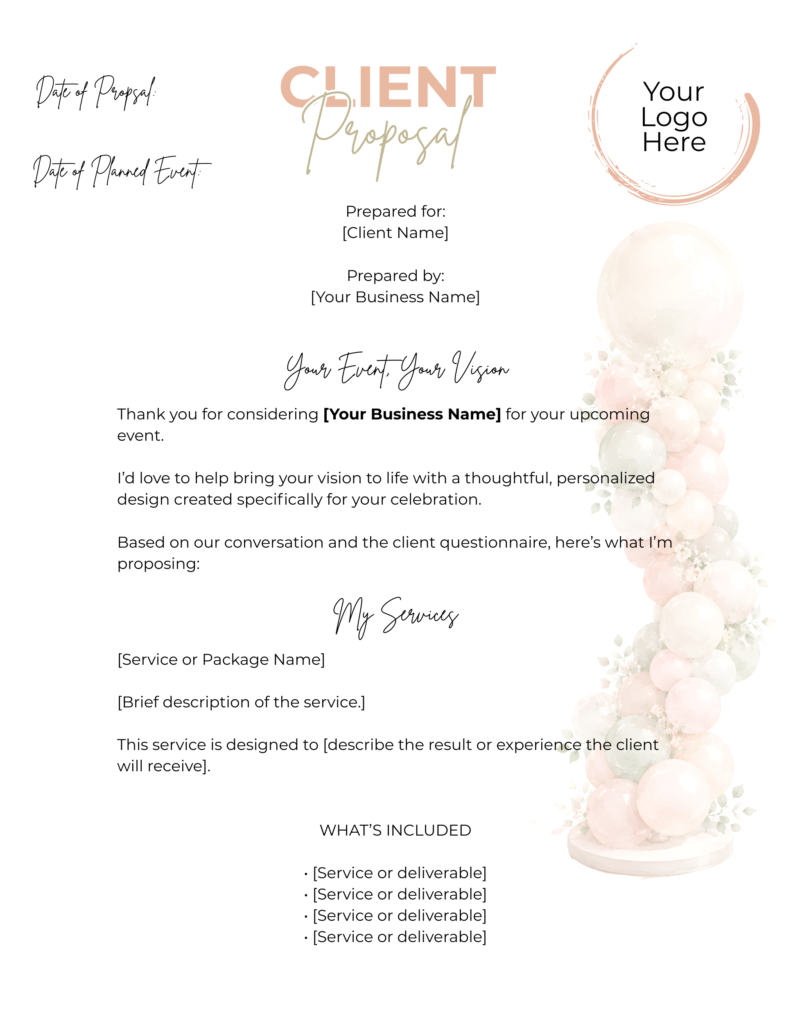
Without a consistent process for contracts, deposits and client information, you could end up building beautiful balloon arches for little to no profit. I’m assuming that’s not why you want to start a business. I’ve created a free proposal form you can use to start.
It’s a 3-page client proposal that can be edited in a free Canva account. At the end of the proposal there’s a spot for clients to sign. I’ve given you the custom graphics for this form as well.
Common Beginner Mistakes
Every new balloon decorator makes a few mistakes along the way. That’s part of learning any new skill. The goal isn’t to avoid every mistake. It’s to learn from them and avoid making the same one twice.
One of the most common mistakes is booking an event without a contract. Everything may seem clear during your conversation, but memories fade. A simple contract gives both you and your client something to refer back to if questions come up later.
Another mistake is forgetting to collect a deposit before reserving the date. It’s exciting when someone wants to hire you, but excitement isn’t a valid payment method. Waiting until the deposit has been received before blocking off your calendar and purchasing supplies helps protect your business.
Speaking of supplies, try not to start shopping too early. It can be tempting to pick up balloons as soon as a client says they’re interested. Resist the urge until you’ve received a signed contract and a deposit. The plans can still change.
Cancellation policies are another thing many beginners overlook. Nobody likes thinking about canceled parties. Having a clear policy before you need one is much easier than trying to make up the rules after a cancellation happens.
It’s also easy to let important information get buried in text messages. A quick conversation here and there doesn’t seem like a problem until you’re scrolling through weeks of messages trying to remember what shade of blue your client wanted. Keeping questionnaires, contracts and event details together in one place will save you a lot of frustration.
Finally, don’t forget to document your work. When the event is over, you’re probably tired and ready to go home. Take a few minutes to photograph the finished display before you pack up your tools. Those photos become your future portfolio, social media content and examples for the next client who asks what you can create. They might even save you a lot of grief if questions come up later about what was delivered or how everything looked when you finished.
Whenever something goes wrong, ask yourself one question:
“How can I keep this from happening again?”
The answer is usually a new step in your workflow, a better checklist or a small change to your process. That’s how businesses improve. One lesson at a time.
Final Thoughts
Congratulations!
If you’ve made it this far, you’ve gone from wondering whether a balloon decorating business was right for you to understanding how to book your very first client. That’s a big accomplishment.
Will you know everything before your first event?
Probably not.
The truth is, every balloon decorator keeps learning. Every client teaches you something new. Every installation helps you improve your skills, refine your workflow and become more confident in your business.
Professionalism doesn’t come from having a huge business. It isn’t hiding in the Amazon box with your new balloon pump.
It comes from showing up prepared.
It comes from communicating clearly.
It comes from having a repeatable system that helps both you and your clients know what to expect.
As you continue your balloon decorating journey, don’t be afraid to adjust your process. You’ll find better ways to organize your supplies, communicate with clients and manage your events. That’s all part of growing a successful business.
Most importantly, don’t wait until everything feels perfect before you begin. Start where you are, keep learning and improve one event at a time.
You don’t have to build the perfect balloon business overnight.
You just have to keep making the next balloon decoration a little better than the last.